
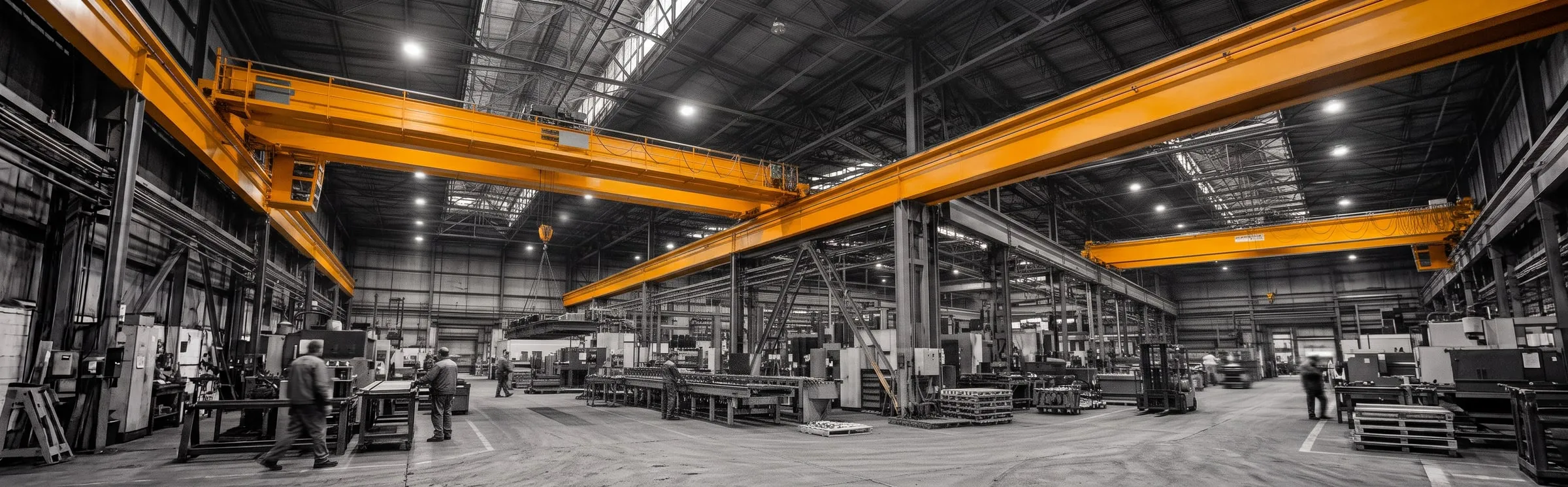
Custom crane manufacturing
Crane manufacturing means calculating and building a lifting system for the load, building dimensions and workload of a particular plant. An off-the-shelf crane is often either heavier and more expensive than needed or wears out early under intensive use. The right crane is one whose capacity, span, lifting height and duty class are set for the site.
At Beta Crane we design and build our cranes in our own factory in Nilüfer, Bursa, with our own engineering team. We run the whole process from engineering and fabrication to installation, load testing and after-sales service. We build cranes from 250 kg up to 40 tons, with bridge spans of up to 40 metres.
What cranes do we build?
- Single girder overhead crane: The most economical solution for light and medium loads in workshops and production halls (1 – 16 tons).
- Double girder overhead crane: For heavy loads, wide spans and intensive use (5 – 40 tons).
- Gantry crane: Full and semi gantry cranes for open yards, storage areas and places where a runway cannot be built.
- Monorail crane: Carrying loads along a single straight or curved track.
- Jib crane: Slewing crane mounted on a column or wall at a workbench or machine.
- Electric hoist and wire rope hoist: The lifting unit of bridge, monorail and jib cranes.
- Components: Crane trolleys, end carriages, control systems and spare parts.
How does crane manufacturing work?
- Site survey and requirements: Building dimensions, column structure, load, lifting height and daily workload are assessed on site.
- Engineering: The duty class is set according to FEM and DIN standards. The main girder, end carriages, wheels and drive groups are calculated and sized for that class.
- Steel structure fabrication: Main girders, end carriages and connection parts are cut, welded and machined in our factory.
- Mechanical and electrical assembly: The hoist, travel motors, brakes, limit switches, control panel and cable carrier system are fitted.
- Surface preparation and painting: Steel surfaces are cleaned and protected with primer and top coat.
- Site installation and commissioning: The runway and rail alignment are checked, the crane is installed, load tested and operators are shown how to use it.
- Handover and service: The technical file, user manual and test report are handed over. Periodic maintenance and breakdown support continue for the life of the crane.
What determines quality in crane manufacturing
- The right duty class: Two cranes of the same capacity are calculated differently if one works a few times a day and the other all shift long. The wrong class means early wear of wheels, gearboxes and rope.
- Girder deflection and stiffness: The main girder must stay within standard deflection limits under load; otherwise the trolley struggles as if driving uphill.
- Runway fit: If the runway and rails under the crane are not straight, even the best crane crabs as it travels. Where needed we also carry out crane runway manufacturing and laser rail alignment.
- Safety equipment: An overload limiter, upper and lower limit switches, emergency stop, warning siren and brake are standard on every crane.
- Spare part continuity: Local manufacturing shortens waiting times for parts, so the crane is not down for long.
Why Beta Crane?
- Built in our own factory: Design, fabrication and installation in one team; one point of responsibility.
- Calculated to standards: Engineering to FEM and DIN; a CE and TSE certified product range.
- Installation and service across Türkiye: Our Bursa-based teams install and maintain cranes at plants in other cities.
- Turnkey: Delivered in working order together with the runway, rails, power supply and controls.
If you are not sure which crane type suits your work, try the crane selector or see our international partnerships page if you are based outside Türkiye.
Frequently asked questions about crane manufacturing
What does the price of crane manufacturing depend on?
Price depends mostly on capacity, bridge span, lifting height and duty class. Single or double girder design, lifting and travel speeds, control type (pendant or radio remote), whether the runway is supplied by us and the installation site also affect it. With this information we prepare a written quotation for your project.
How long does crane manufacturing take?
It depends on the crane type, capacity and our workload. A standard single girder overhead crane and a heavy, double girder special project do not take the same time. Our quotation states the fabrication and installation schedule separately.
Can you build a new crane for my existing runway?
Yes. We measure the span, rail type and condition of the existing runway on site and build the crane to suit it. If the runway is misaligned or worn, we recommend correcting it before fabrication.
Do you install cranes outside Bursa?
Yes. We build our cranes in our factory in Bursa and install, commission and service them at plants across Türkiye with our own team.
Which standards are your cranes built to?
Our cranes are calculated to FEM and DIN standards according to their duty class. Our product range is CE and TSE certified. Each crane is load tested before use and the test report is handed over.