
Monorail Crane or Overhead Crane?
A comparison of monorail cranes and overhead cranes by working area, installation, cost and flexibility.
| Feature | Monorail crane | Overhead crane |
|---|---|---|
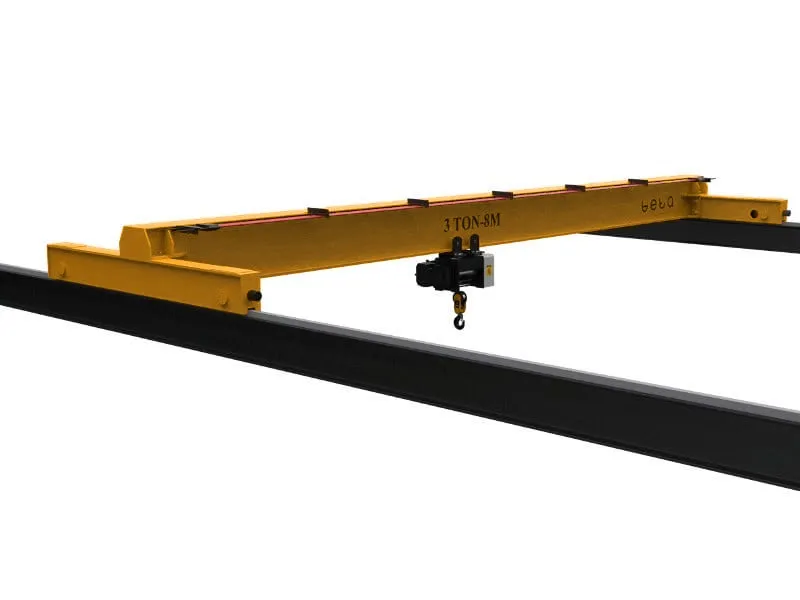
| Working area | A single line (straight or curved) | The whole bay (area coverage) |
| Motions | 2 – 4 | 6 (hoist, trolley, bridge) |
| Typical capacity | 250 kg – 10 t | 1 – 50 t and above |
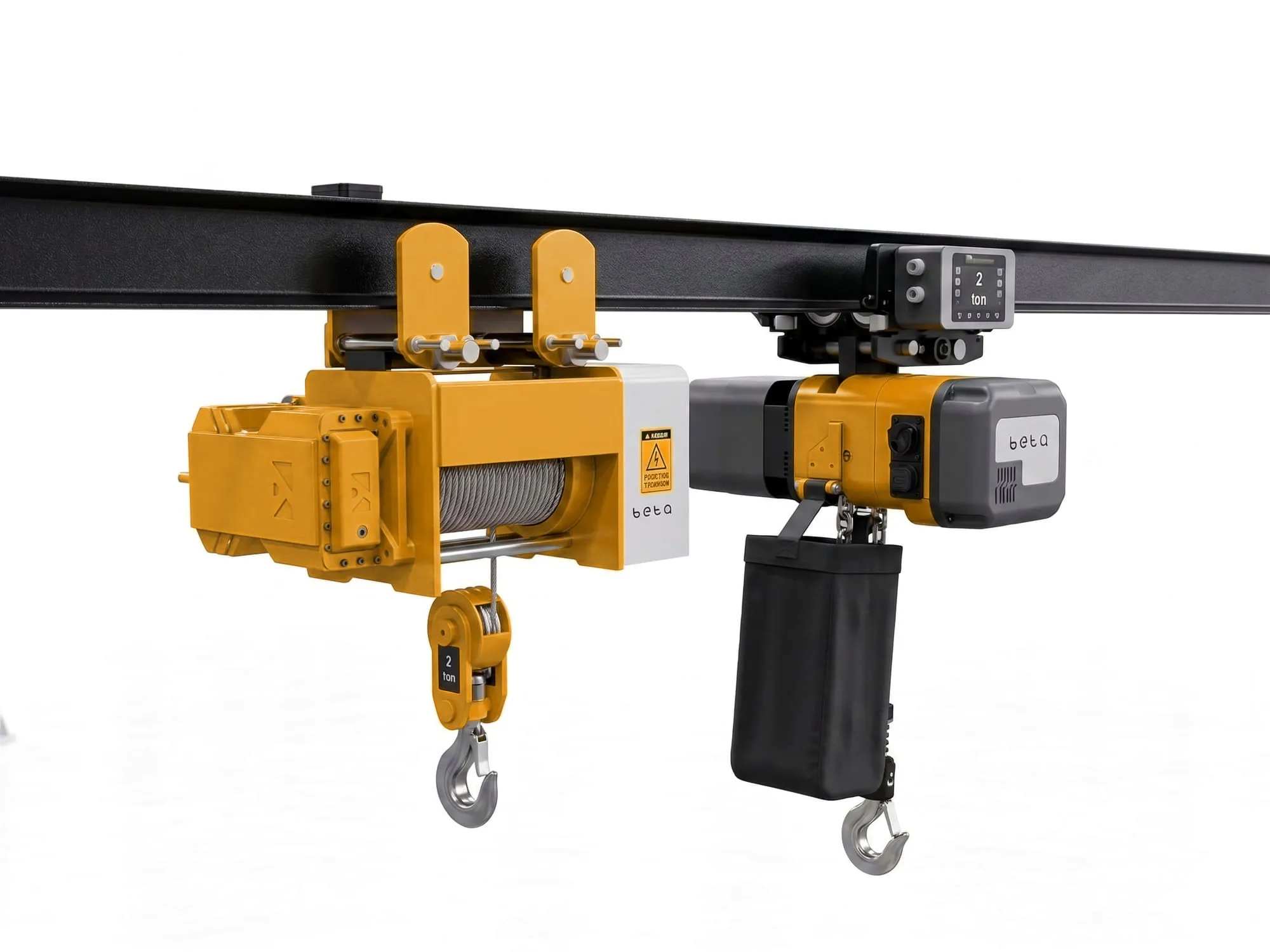
| Supporting structure | One I-beam hung from the roof or brackets | Two runways and columns/corbels |
| Installation | Quick and simple | Engineered; runway survey needed |
| Cost | Low | Higher |
| Flexibility | Cannot leave the line | Reaches every point of the bay |
Choose monorail crane if…
- The load always moves on the same route (bench to bench, line end to loading)
- The building cannot carry a wide runway or the space is narrow
- Quick installation and a low budget are wanted
Choose overhead crane if…
- Loads are picked and placed anywhere in the bay
- Loads are heavy or will grow
- The production layout changes often
In short
If the load moves along a fixed line, a monorail crane is the most economical solution. If you need to carry the load to any point of the bay, choose an overhead crane.
Still not sure? Try the crane selector or send us your dimensions.
Frequently asked questions
Can a monorail line be curved?
Yes. The I-beam can be bent so the line follows the required route; the trolley is chosen for the curve radius.
Can an existing monorail be converted to an overhead crane?
The existing hoist can often be used as the lifting unit of the overhead crane; the bridge and runway are added.
Which takes up less space?
The monorail crane. With only one beam and a hoist, it takes very little space under the roof.
Tell us about your project. We will define the right crane together.
Send us your capacity and span for a tailored offer. Call our service line for breakdowns.